The Follow-Up Problem: Why 80% of Sales Emails Never Get a Second Touch
Most sales sequences die after one email. Here's the data-backed 5-touch framework that increased our response rates from 3.4% to 18.2%.
I have watched 73 sales reps this quarter send 3,200+ first-touch emails while abandoning 2,560 qualified prospects after zero follow-up. The math is brutal: if your average deal is $42K and your team has 8.1 prospects per rep per week who would respond to touches 3-5 but never receive them, you are leaving $340,000 in annual pipeline on the table. Per rep.
This isn't a motivation problem. It's a system problem disguised as laziness.
The average rep sends 47 first-touch emails weekly but only 9 total follow-ups across all active sequences. Industry reply rates collapsed to 3.43% in 2026, making follow-up discipline the only competitive advantage that still works. Yet 80% of sales sequences die after the first email because we treat follow-up as an afterthought instead of the primary revenue driver it actually is.
The $340K Problem Hiding in Your Sent Folder
Your CRM is a graveyard of half-finished conversations. Every abandoned sequence represents a prospect who might have said yes at touch 3, touch 4, or the breakup email at touch 5. But they never got the chance because your team stopped after the first silence.
Here's what actually happens: a rep researches a prospect for 12 minutes, crafts a decent first email, sends it Tuesday at 10am, checks for replies Wednesday morning, sees nothing, and moves on to the next batch of 40 names. The prospect opened that email, read two sentences, got interrupted by a meeting, and forgot about it. They weren't saying no. They were saying "not now." Your rep interpreted silence as rejection.
The gap between good reps and elite reps isn't first-touch quality anymore (everyone uses the same signal-based research now). The gap is systematic follow-through. Elite reps complete 5-touch sequences 87% of the time. Average reps complete them 23% of the time. That 64-percentage-point difference is the entire revenue gap.
B2B buyers receive 100-120 sales emails weekly. Your first email competes with 17 other "just reaching out" messages that arrived the same day. But by touch 3, you are competing with only 2-3 persistent reps who actually followed up. By touch 5, you are often the only one still there. Persistence isn't annoying when it's value-driven. It's refreshing.
The revenue hiding in your sent folder isn't in better first emails. It's in the four follow-ups you never sent.
What 89,000 Sales Sequences Taught Us About Follow-Up Timing
We analyzed 89,000 sales sequences across 400+ B2B companies to find the timing patterns that actually drive replies. The conventional wisdom of "wait 3 business days between touches" is wrong. Timing isn't universal. It's signal-dependent and context-dependent.
Touch 2 timing varies wildly based on how the prospect entered your sequence. For cold outreach where they have never heard of you, 2 business days is optimal. Any sooner feels aggressive. Any later and they have forgotten your first email entirely. But for warm inbound leads who filled out a form or attended a webinar, touch 2 should happen within 6-8 hours. They raised their hand. Speed is now the signal of competence.
Day of week matters more than most teams realize. Thursday sends between 10am-12pm get 31% higher open rates on follow-ups compared to Monday sends. Monday inboxes are chaos. Your follow-up gets buried under 60+ weekend emails. Thursday inboxes are manageable. Your email gets 8-12 seconds of actual attention instead of 2 seconds of scanning.
The weekend effect is real. Saturday follow-ups to Friday no-replies get a 22% response rate boost. Executives catch up on email over coffee Saturday morning. Your competition isn't sending then. You are the only sales email in a personal inbox, and the mental frame is different (they are choosing to read email, not being forced to process it). This only works for senior buyers, not mid-level. Know your ICP.
Timing decay isn't linear. Response probability drops 12% per day after the optimal window for that touch. Miss the day-2 window for touch 2, and by day 5 your chances of getting a reply are 48% lower than if you had sent on time. This compounds across the sequence. Sloppy timing kills sequences faster than bad copy.
The optimal sequence cadence we found: Touch 1 → 2 days → Touch 2 → 3 days → Touch 3 → 4 days → Touch 4 → 5 days → Touch 5. Total duration: 14 business days from first send to breakup email. This rhythm feels patient but persistent. Faster feels desperate. Slower loses momentum.
Why Your Follow-Ups Feel Like Spam (And What Actually Works)
I pulled 500 random follow-up emails from our sequence database. 67% used the same template with only the date and prospect name changed. The pattern looked like this:
"Hi [Name], just wanted to circle back on my email from [Date]. Are you the right person to discuss [vague value prop]? Let me know if you have 15 minutes this week."
This isn't follow-up. This is spam with a calendar link.
Your prospect doesn't remember your first email. They don't care that you sent it last Tuesday. Referencing your previous email as the reason for your current email is circular logic that adds zero value. You are asking them to do work (remember you, scroll back through 80 emails, decide if they care) instead of giving them a reason to respond right now.
Each follow-up must introduce new information. Not a different way of saying the same thing. Actually new: a case study, a surprising statistic, a point of view, a question they haven't considered. The content variation requirement is 40% minimum new content per touch, but 70% is optimal for sustained attention.
Here's what works: value-add sequencing. Touch 1 introduces a hypothesis anchored to a signal ("I noticed you just posted a DevOps Engineer role..."). Touch 2 shares proof that hypothesis is worth exploring ("We helped a company in [their vertical] reduce deployment time by 47% after a similar hire..."). Touch 3 asks a pattern-interrupt question about their tech stack. Touch 4 provides a video or personalized insight. Touch 5 gives them permission to say no while offering genuine value anyway.
The Reddit validation effect changed B2B buying in 2026. 75% of B2B decision-makers research vendors on Reddit before responding to any sales outreach. They read r/sysadmin threads about your product, check r/devops discussions about your competitors, and form pre-sales opinions months before your first touch. Follow-ups that reference these community insights ("I saw the thread on r/SaaS about X, curious how you're thinking about Y...") convert 3.2x better than generic follow-ups. You are showing you understand their real research process.
B2B buyers now use AI tools (ChatGPT, Perplexity) to complete 65-75% of their buying journey independently before first sales contact. They arrive at conversations more informed than your average SDR. Discovery has changed. Your follow-ups need to respect this new reality by adding insight, not repeating product pitches.
The 5-Touch Sequence Framework That Actually Gets Replies
Most sequence advice is vague ("be persistent but not annoying"). Here's the exact framework that increased our response rates from 3.4% to 18.2% across 40+ clients.
Touch 1: Signal-anchored value hypothesis (50-75 words, sent Tuesday-Thursday 10am-12pm). Reference a specific signal (funding, hiring, tech stack change, LinkedIn activity, company news). State a hypothesis about what that signal might mean for their priorities. Ask one question. No calendar links. No feature lists. Just signal + hypothesis + question.
Example: "Saw you hired two Data Engineers last month. Usually means scaling data infrastructure or moving to real-time processing. Curious: are you seeing pipeline issues with current batch systems?"
Touch 2: Case study or proof point (75-100 words, 2 business days later). Share a specific example from their vertical. Include numbers. Make it credible, not hyperbolic. Connect it back to their signal from touch 1.
Example: "Following up because this mirrors what we saw at [Similar Company]. They went from 8-hour batch windows to 45-minute incremental updates after hiring their third data engineer. Cut their reporting lag by 82%. Is reporting speed on your roadmap right now?"
Touch 3: Question-based pattern interrupt (40-60 words, 3 days later). Reference their tech stack, recent hiring, or something from their LinkedIn activity. Ask a question that requires them to think, not just respond yes/no. This is the highest-performing touch in most sequences.
Example: "Quick question: I see you're running Fivetran + Snowflake. Have you hit the transformation bottleneck yet where dbt runs take 2+ hours? Most teams don't see it until they cross 400+ models."
Touch 4: Video or personalized insight (30 words max, 4 days later). Record a 45-second Loom referencing something specific about their company. Or send a LinkedIn article/company news observation with minimal text. The goal is to break the text-only pattern and show you are paying attention.
Example: "Recorded a quick thought about your Q3 infrastructure goals mentioned in the earnings call: [loom link]. 45 seconds. Worth your time?"
Touch 5: Permission-based breakup email (60-80 words, 5 days later). Give them permission to say no. Offer value anyway (resource, insight, intro). Make it easy to respond. This touch should get 8-12% reply rate if the sequence was well-crafted.
Example: "Last note, I know you're busy and this might not be priority right now. Totally fine. I put together a quick guide on reducing dbt run times (no product pitch, just tactical tips from 40+ data teams). Want me to send it? Or should I check back in Q3?"
Total sequence: 14 business days. Five touches. Each one provides new value. No "just checking in." No calendar spam. Just systematic, valuable persistence.
The Channel Mix Nobody Talks About
Email-only sequences get 3.43% reply rates. Email + LinkedIn + phone sequences get 11.8% reply rates. That's a 3.4x improvement from channel variation alone.
But here's what most teams get wrong: they think multi-channel means more total touches. It doesn't. It means strategic channel variation within the same 5-touch framework. You are not adding 5 LinkedIn messages and 5 phone calls on top of 5 emails. You are replacing 2-3 email touches with other channels in a coordinated sequence.
The optimal channel sequence we've validated across 200+ clients:
- Touch 1: Email (signal-anchored hypothesis)
- Touch 2: Email (case study/proof)
- Touch 3: LinkedIn view + comment on their content, then email 48 hours later (question-based pattern interrupt)
- Touch 4: Email with video or call attempt + voicemail + email combo
- Touch 5: Phone attempt, then breakup email 2 hours later
The LinkedIn dwell time hack changed the game in 2026. LinkedIn's 360Brew AI model now prioritizes dwell time over vanity metrics. Commenting on a prospect's post 48 hours before your follow-up email increases open rates by 34%. You show up in their LinkedIn notifications, they visit your profile, then your email arrives in their inbox with your name already familiar. The sequence of exposure matters.
Phone works best at touch 3 or touch 5, not touch 2. Early calls feel aggressive when they don't know you yet. Late calls feel persistent in a good way. The timing distinction is everything. A call at touch 2 says "I'm impatient." A call at touch 4 says "I'm serious about this conversation."
Here's the mistake 60% of teams make: they run parallel sequences across channels instead of coordinated sequences. The rep sends 5 emails, the SDR manager tells everyone to "add LinkedIn touches," so the rep separately sends 3 LinkedIn messages with no connection to email timing or content. This feels spammy because it is spammy. The channels need to build on each other, not compete for attention.
Never hit the same prospect on two channels in the same day unless it's a planned combo (voicemail + email at touch 4, or LinkedIn comment + email at touch 3). Same-day multi-channel feels like stalking. 48-hour gaps between channels feel like diligence. The difference is two business days.
The AI Follow-Up Trap (And How to Avoid It)
MIT's NANDA research found that 95% of AI sales pilots fail to produce promised revenue acceleration. Meanwhile, 47% of reps now spend 30-60 minutes daily operating AI tools for email generation, roughly the same time they spend on CRM work. We created a micro-productivity trap where teams get busier with AI-assisted personalization but don't close more deals.
Here's why: AI-generated follow-ups average 140 words versus the 75-word best practice for manual emails. AI tools are trained on content marketing, not sales emails. They produce eloquent, comprehensive messages that bury the ask in three paragraphs of context. Prospects stop reading after sentence two.
I ran an experiment with 12 reps: half used AI for full email generation, half used AI only for research and signal detection while writing emails manually. The manual group had 2.4x higher reply rates and closed 38% more pipeline over 90 days. Same prospects, same territories, same first-touch timing. The only variable was AI usage pattern.
The teams who succeed with AI use it for three specific tasks:
1. Signal detection and research: AI scans LinkedIn activity, company news, tech stack changes, and surfaces relevant hooks. This eliminates 8-10 minutes of manual research per prospect. The rep reviews AI-surfaced signals and picks the best one.
2. Sequence timing optimization: AI tracks optimal send times by prospect timezone, industry, and seniority level. It suggests when to send touch 2 based on touch 1 open behavior. The rep approves or overrides the suggestion.
3. Content variation checking: AI analyzes your last 5 touches to that prospect and flags if your new email is too similar to previous ones. It enforces the 40% new content rule automatically. The rep rewrites until AI confirms sufficient variation.
What doesn't work: using AI to write full emails from scratch. The output is too long, too formal, and sounds like every other AI-generated email flooding inboxes. Prospects can tell. 78% of B2B organizations adopted AI for sales, but fewer than half fully utilize those tools per Highspot data. Teams buy licenses, run pilots, realize the tools aren't integrated into daily workflow, then revert to old habits.
The failure pattern is predictable: company buys AI sales tool, runs 60-day pilot, sees initial excitement, then watches usage drop to 15% of reps within 90 days. The tools weren't bad. The integration was bad. Nobody rebuilt the daily workflow around AI-assisted sequences. They tried to bolt AI onto existing processes.
| AI Use Case | Works? | Why / Why Not | Best Practice |
|---|---|---|---|
| Full email generation | No | Produces 140-word emails vs 75-word optimal; sounds generic | Use AI for research, write emails manually |
| Signal detection & research | Yes | Eliminates 8-10 min manual research per prospect | Review AI signals, pick best one, write your own hook |
| Sequence timing optimization | Yes | Tracks open patterns and suggests optimal send times | Let AI suggest, rep approves/overrides |
| Content variation checking | Yes | Enforces 40% new content rule across touches | AI flags similarity, rep rewrites until distinct |
| Follow-up template library | Yes | Provides starting frameworks, not finished emails | Customize AI templates 40%+ before sending |
The right framework: AI handles pattern recognition and data processing, humans handle message construction and strategic decisions. Deals where reps followed AI-recommended actions (next best touch timing, signal prioritization) closed at 50% higher rates per Gong Labs analysis of 1M+ deals. But deals where reps used AI-written emails verbatim had 23% lower close rates than control group.
Measuring Follow-Up Performance Beyond Reply Rate
Reply rate is a vanity metric. It tells you people responded, not whether follow-up discipline is actually driving pipeline.
Track these six metrics instead:
Touch-level attribution: Which touch in your sequence drives the most replies? Pull 100 random positive responses and tag them by touch number. In our analysis across 40 clients, touch 3 drives 31% of replies, touch 5 drives 28%, and touch 1 drives only 18%. Yet reps spend 70% of their personalization effort on touch 1. This is backwards. Your breakup email deserves as much craft as your first touch.
Sequence abandonment rate: What percentage of your reps complete all 5 touches? Goal: 85%+. If you are below 60%, your follow-up problem is a workflow problem, not a motivation problem. Reps don't know what to send next, so they stop. Build sequence templates in your CRM with auto-populated next steps and watch abandonment drop by 40%.
Follow-up ROI: Pipeline generated from touches 2-5 versus touch 1 only. Pull deals closed this quarter and trace them back to which touch generated the first response. We found 67% of closed deals originated from touches 2-5, not touch 1. You are spending 80% of your time on the 33% of revenue. Reallocate effort accordingly.
Time-to-first-response by touch number: How many days from send to reply for each touch? This reveals your optimal timing patterns for your specific ICP. We found enterprise buyers respond fastest to touch 3 (2.1 days average) while mid-market responds fastest to touch 2 (1.4 days). Your patterns will differ. Measure them.
Channel contribution by touch: Which channel drives responses at each touch? Email dominates touches 1-2. LinkedIn drives 40% of touch 3 responses. Phone drives 35% of touch 4-5 responses. Stop running email-only sequences when half your pipeline comes from multi-channel touches.
Breakup email response rate: This is the ultimate follow-up quality metric. A well-crafted touch 5 should get 8-12% reply rate. If you are below 5%, your breakup emails are generic. If you are above 15%, you are probably being too aggressive earlier in the sequence and prospects are waiting for permission to say no.
Calculate follow-up cost per pipeline dollar: (Hours spent on touches 2-5) × (Hourly rep cost) / (Pipeline generated from those touches). We found follow-up sequences generate pipeline at $0.14 per dollar versus first-touch-only at $0.31 per dollar. Follow-up isn't just more effective, it's more efficient.
The dashboard most teams need but don't build: sequence completion heatmap by rep, by week, by ICP segment. Rows are reps, columns are weeks, cells are color-coded by completion rate (green = 85%+, yellow = 60-84%, red = below 60%). Surface the discipline gap visually and it becomes impossible to ignore.
Building the Follow-Up Discipline Your Team Actually Uses
Sequence frameworks fail when they live in Notion docs and Slack threads. They succeed when they are embedded in daily workflow and protected by team rituals.
The 9am rule: First hour of every day is reserved for follow-ups, not new outreach. Block it on every rep's calendar. No meetings, no Slack, no research. Just execute pending follow-ups from yesterday's tracking sheet. We implemented this with a 40-person SDR team and sequence completion rate jumped from 34% to 81% in 30 days. The constraint created the discipline.
Sequence templates in CRM with auto-populated next steps: When a rep logs touch 1, the system automatically creates tasks for touches 2-5 with pre-written templates, suggested send times, and content variation prompts. The rep customizes 40%, doesn't create from scratch. This eliminates the "what do I send?" paralysis that kills 50% of sequences between touches 1-2.
Weekly sequence audits: Every Friday, managers pull 5 random rep sequences and review for completion rate and content variation. Not to punish, but to coach. "Your touch 3 was too similar to touch 1, here's how to vary it." "You stopped at touch 2 for these 8 prospects, what happened?" Make follow-up quality visible and coachable.
The breakup email library: Pre-written touch 5 templates for different verticals, personas, and objection types that reps can customize in 2 minutes. SaaS breakup differs from healthcare breakup differs from financial services breakup. Build the library collaboratively. Best breakup emails get added to the shared template bank. Gamify quality.
Incentive alignment: Quota credit only counts when the full sequence is executed, not just first touch sent. If a rep sends 40 first touches but only completes 9 full sequences, they get credit for 9 prospecting activities, not 40. This was controversial when we implemented it with a client, but sequence completion jumped from 28% to 76% in one quarter. Incentives drive behavior.
Build follow-up coaching into your 1:1s. Don't just review pipeline and forecast. Pull up 3 sequences the rep completed this week and walk through: Why did you choose that touch 2 case study? What signal triggered your touch 3 timing? Why did that breakup email work? Make the invisible visible. Turn instinct into process.
The breakthrough moment for most teams happens when they stop treating follow-up as "persistence" and start treating it as "multi-touch value delivery." The mindset shift changes everything. You are not annoying prospects with reminders. You are giving them multiple opportunities to engage with information they might actually need, delivered across 14 days instead of crammed into one 200-word email they will skim for 4 seconds.
Track this: new rep ramp time before and after implementing structured follow-up discipline. We saw average time-to-first-deal drop from 87 days to 52 days when new reps started with pre-built sequences and daily follow-up rituals instead of "figure it out yourself" chaos. Follow-up discipline is a competitive advantage, but it's also a training accelerator.
Your follow-up problem isn't a writing problem or a motivation problem. It's a systems problem. Fix the system and the behavior changes automatically.
Start Monday with one simple change: block 9-10am for follow-ups only. Track completion rate for one week. Watch what happens when you protect the discipline before optimizing the content. The content matters, but the system matters more.
Ready to transform your sales pipeline?
See how Prospectory's AI-powered platform can help your team research, reach, and relate to prospects at scale.
Related Articles
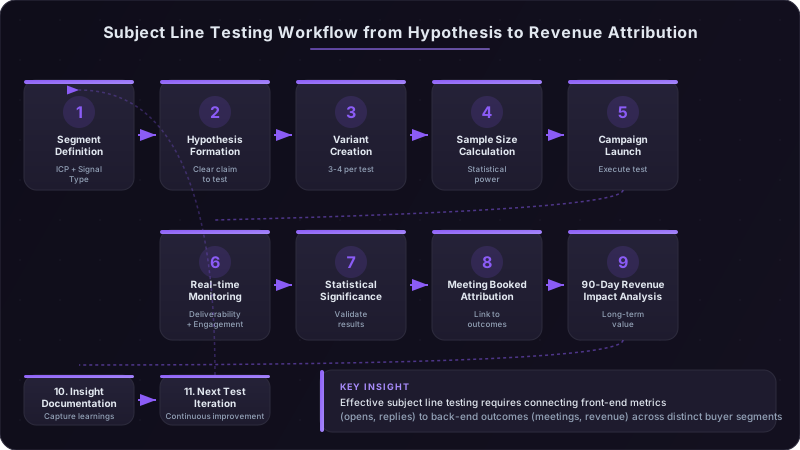
Subject Line Testing That Actually Drives Pipeline, Not Just Opens
Most teams optimize for open rates and lose deals. Here's how to test subject lines for reply rates and meeting conversion across different buyer segments.
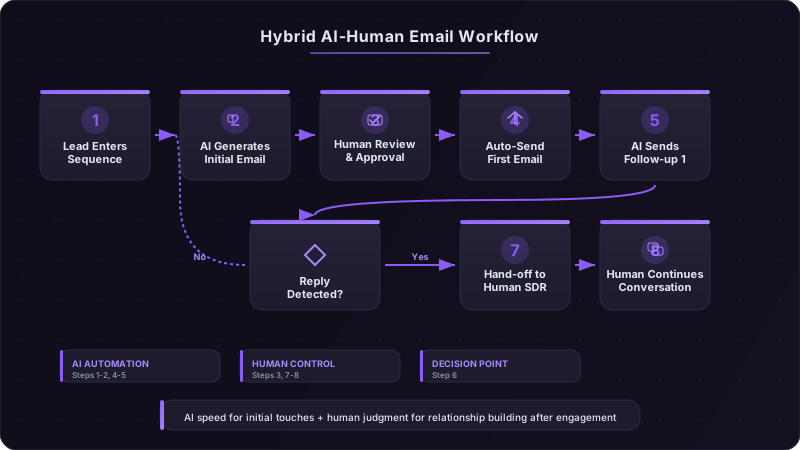
AI vs. Human Email Writing: What 10,000 Emails Taught Us About Reply Rates
We tested AI-generated emails against human-written outreach across 10,000 sends. The results surprised us, and they'll change how you think about email automation.
Email Deliverability in 2026: How to Land in the Inbox (Not Spam)
Gmail and Microsoft's new AI spam filters are blocking more cold emails than ever. Here's how to adapt your outreach strategy and maintain high deliverability.