Why 58% of Your Replies Come From Email #1 (And How to Fix the Rest)
Most replies happen on your first email, not your seventh. Here's the sub-80-word framework, signal-based personalization tactics, and data that prove long sequences are dying.
I ran a test last quarter that made me rethink everything I knew about sales sequences. I took 1,200 cold emails sent by my team over 90 days and mapped every positive reply to the touch number that generated it. The result was brutal: 58% of positive replies came from email number one. Not from the clever follow-up on day seven. Not from the "just bumping this" on day fourteen. From the very first email.
That number should make every SDR manager uncomfortable. Because if more than half your wins come from touch one, and you're spending 80% of your sequence design effort on touches four through twelve, you're optimizing the wrong thing. You're polishing a car that already drove past the buyer.
The data gets worse the deeper you look. And it points to a clear conclusion: your first email deserves almost all of your creative energy, your best personalization, and your tightest writing. Everything after that is damage control.
The Reply Curve Nobody Showed You
Here's the reply distribution I found, which aligns closely with data from teams I've compared notes with across SaaS, fintech, and professional services:
- Touch 1: 58% of positive replies
- Touch 2: 22% of positive replies
- Touch 3: 11% of positive replies
- Touches 4 through 12: 9% combined
That last number is the one that should sting. Nine percent of your positive replies come from seven additional emails. Seven emails that cost you time, deliverability, and (increasingly) domain reputation.
So why do sales teams still default to 7, 10, or even 12 touch sequences? Three reasons. First, legacy playbooks. The "it takes seven touches" myth has been repeated so many times it feels like physics. Second, sunk cost fallacy. If you've already sent six emails, sending two more feels like persistence, not waste. Third, vanity metrics. Sequence completion rates look great on dashboards but tell you nothing about revenue.
The core thesis is simple: your first email deserves 80% of your optimization effort. Not the cadence. Not the follow-up timing. The first email. And when you combine that focus with signal-based selling (which consistently produces 2 to 4x higher reply rates than generic outreach), the first-touch advantage compounds dramatically.
Why Your First Email Carries All the Weight
Your first email sets the frame for every subsequent interaction. A mediocre first email doesn't just get ignored. It poisons the entire sequence. Once a prospect mentally categorizes you as "another vendor pitch," every follow-up gets filtered through that frame. No amount of clever copywriting on email four can undo a generic first impression.
The buyer side of this equation has shifted too. Research shows 84% of B2B buyers now feel prepared before they ever talk to a seller, largely because AI-powered research tools let them pre-qualify vendors on their own. Your first email either validates an interest they already have, or it lands as noise. There's almost no middle ground.
Then there's the volume problem. The average B2B decision-maker receives 120 or more outreach emails per month. That's four per day from people who want something. Email number one might get a genuine read. By email four, you're a notification to dismiss. By email eight, you're training their spam filter.
The domain reputation math alone should kill long sequences. If you're sending at 30 to 40 emails per day (the safe deliverability range most experts recommend), a 10-touch sequence means you can only work 3 to 4 new prospects per day per mailbox. That's a terrible use of your sending capacity when 58% of replies come from touch one anyway.
The Sub-80-Word Framework That Actually Converts
I've tested dozens of email structures. The one that consistently wins is embarrassingly simple: four sentences, each doing one job.
The anatomy
- 1Signal Hook (1 sentence): Reference a specific, timely trigger the prospect will recognize.
- 2Pain Connection (1 sentence): Link that signal to a problem they're likely facing right now.
- 3Credibility Proof (1 sentence): One specific result with a number, company size, or timeframe.
- 4Single CTA (1 sentence): One clear, low-friction ask.
Total: 60 to 80 words. That's it.
Before and after: the generic disaster
Before (187 words, 2.1% reply rate):
"Hi Sarah, I hope this email finds you well. I'm reaching out because I noticed your company is growing rapidly and I wanted to introduce our platform that helps sales teams improve their outreach effectiveness. We work with hundreds of companies across the SaaS space to help them book more meetings and grow pipeline. Our clients typically see a 30-40% improvement in their sales metrics after implementing our solution. I'd love to schedule a 15-minute call to discuss how we might be able to help your team achieve similar results. Would Tuesday or Thursday work for a quick chat? Looking forward to hearing from you."
After (67 words, 14.3% reply rate):
"Hi Sarah, saw Acme just closed their Series B and posted three SDR roles last week. Scaling outbound with a new team usually means 60+ days before reps are fully ramped. We helped a similar Series B team (Finley, 45 employees) cut that ramp to 28 days and hit quota in month two. Worth a 15-minute look at how we did it?"
The second email works because every sentence earns the next one. The signal proves you did your homework. The pain connection shows you understand the implication. The proof removes skepticism. The CTA is specific and low-commitment.
Why brevity wins
64% of B2B email opens happen on mobile devices. On a phone screen, 187 words is a wall of text requiring a scroll. 67 words fits on the screen without scrolling. Cognitive load research confirms what your inbox behavior already tells you: shorter messages get faster decisions. And the "reply effort" principle matters too. A short email implies a short reply is acceptable. A long email creates pressure to respond with equal length, so most people just don't.
Signal Stacking: The Personalization That Doesn't Feel Creepy
Single-signal personalization is table stakes. "Congrats on the funding" gets a 4% reply rate because every other SDR is sending the same email. The difference is in signal stacking, combining two or three signals to create an email that feels like it was written by someone who genuinely understands the prospect's situation.
The three signal layers
- Company signals: Funding rounds, hiring surges, tech stack changes, geographic expansion, regulatory triggers
- Persona signals: Role changes (especially in the last 21 days), LinkedIn activity, conference attendance, podcast appearances
- Pain signals: Competitor complaints on G2, Reddit threads discussing alternatives, support ticket patterns, negative Glassdoor reviews mentioning tooling
When you combine two or three of these, reply rates jump to 34%. That's not a typo. It's the difference between "I know your company name" and "I understand the specific challenge you're facing this month."
Signal decay is real
Not all signals have the same shelf life. Funding announcements are gold within the first 3 days. By day 45, every SDR and their automation tool has already emailed about it. Leadership changes have roughly a 21-day window before the new VP is inundated with vendor pitches. Hiring surges (visible through job postings) stay relevant for about 30 days.
This is where Reddit has become surprisingly valuable. Over 40% of B2B conversations on Reddit now involve product research and purchase decisions. When a prospect's target persona posts a question like "anyone switch from [Competitor] to something better for mid-market?" on r/sales or r/SaaS, that's a real-time pain signal with a shelf life of about 72 hours. Buyers trust anonymous peer reviews on Reddit far more than branded content, and they're increasingly using "site:reddit.com" searches to bypass vendor SEO entirely.
Practical example
Here's a signal stack that writes the email for you:
- Company signal: Closed $8M Series A (announced 4 days ago)
- Persona signal: New VP of Sales started 3 weeks ago
- Pain signal: Competitor G2 review from their company mentioning data quality issues
The email: "Hi Marcus, congrats on the Series A. Three weeks into a new VP role with fresh capital, you're probably building your outbound motion from scratch. Noticed your team flagged data quality in a recent G2 review of [Competitor]. We helped [Similar Company] fix that exact problem and increase qualified pipeline 3x in one quarter. Worth 15 minutes to compare approaches?"
That's 63 words. Three signals. One clear ask. It doesn't feel creepy because every signal is publicly available. It feels like someone who actually paid attention.
Never use more than three signals in a single email. Two to three signals show genuine research. Four or more signals make the prospect feel surveilled. The sweet spot is one company signal plus one persona signal plus one pain signal, combined in under 80 words. Test this against your current first email and measure positive reply rate over a 50-email batch.
The 7-12 Touch Sequence Is a Deliverability Liability
Let's do the math that kills the long sequence.
Most deliverability experts recommend staying within 30 to 40 sends per day per mailbox to maintain a healthy sender reputation. If you're running a 10-touch sequence, each prospect consumes 10 of those sends over the sequence lifecycle. That means one mailbox can only support 3 to 4 new prospects per day.
With a 3-touch signal-triggered sequence, that same mailbox supports 10 to 13 new prospects per day. Triple the pipeline capacity, from the same infrastructure.
Email service providers have also gotten smarter. Gmail and Microsoft now track sender-to-recipient engagement ratios. Ten unanswered emails to the same person is not persistence. It's a spam signal. Your domain reputation degrades with every ignored email, and rebuilding it takes weeks.
This connects to a broader trend: teams are consolidating from 10 to 15 sales tools down to 3 to 5 core platforms, and they're cutting sequence length at the same time. Complexity has a real cost in tool overhead, training time, and cognitive load for reps. One team I worked with cut their tool budget from $247K to $68K while booking 40% more meetings, largely by switching from a 12-touch automated sequence to a 3-touch signal-triggered approach.
| Metric | 10-Touch Generic | 3-Touch Signal-Triggered | Winner |
|---|---|---|---|
| Positive reply rate | 1.8% | 12.4% | 3-Touch |
| Meetings per 100 prospects | 0.9 | 4.2 | 3-Touch |
| New prospects per mailbox/day | 3-4 | 10-13 | 3-Touch |
| Domain reputation risk | High (10 unanswered sends) | Low (3 sends max) | 3-Touch |
| Rep time per prospect | 25 minutes | 12 minutes | 3-Touch |
| Tool complexity required | 4-6 tools | 2-3 tools | 3-Touch |
The 3-touch model wins on every dimension that matters. The only metric where long sequences look better is "total activity logged," which is a vanity metric that has never correlated with revenue in any team I've managed.
What Email #2 and #3 Should Actually Do
If email #1 carries 58% of the weight, emails two and three still matter for the remaining 33%. But they need to do fundamentally different jobs than most teams assign them.
Email #2 is not a follow-up. It's a new signal or proof point. If email #1 referenced a funding round, email #2 might reference a specific hiring pattern you noticed or a case study from a company at the same stage. Timing: send it 72 hours after email #1. Not 24 hours (too aggressive). Not 7 days (they've forgotten you).
Email #3 is a breakup with value. Share something useful: a relevant benchmark, a case study PDF, or even a Reddit thread where their peers are discussing the exact problem you solve. Give a clean exit: "If this isn't a priority right now, no worries. Thought this [resource] might be useful regardless." This gets a surprising number of replies because it removes the pressure of commitment.
The multi-channel layer
The highest-performing reps I've worked with don't treat email as a standalone channel. They use a sequencing psychology that looks like this:
- 1LinkedIn profile view before email #1 (creates subconscious familiarity)
- 2LinkedIn comment on their content before email #2 (adds social proof)
- 3Phone call at 4 to 5pm if the persona warrants it (CFOs ignore this, VPs of Sales pick up)
This warm-up-first model (LinkedIn signals before email asks) produces 15 to 25% response rates versus 3% for email-only. LinkedIn DMs alone achieve roughly 10% reply rates, about double what most cold email campaigns get. The gap between generic automation and signal-triggered multichannel outreach is 6 to 15x on meeting booking rate.
Measuring What Actually Matters on Email #1
Stop tracking open rates. With Apple Mail Privacy Protection and similar features, open rates are unreliable noise. A "98% open rate" tells you almost nothing about whether your email worked.
Instead, track three metrics on your first email:
- Positive reply rate: Any reply that isn't "unsubscribe" or "not interested." Target 8 to 12% for signal-triggered first emails.
- Meeting conversion rate: Percentage of first emails that directly result in a booked meeting. Target 3 to 5%.
- Time-to-first-reply: How quickly prospects respond. Under 4 hours usually indicates strong signal relevance. Over 48 hours usually means they're being polite, not interested.
A/B testing that produces real answers
Test one variable at a time on email #1. Run each test against a batch of at least 50 sends to get meaningful signal. Variables worth testing, in priority order:
- 1Signal type (funding vs. hiring vs. competitor pain)
- 2CTA style (specific time ask vs. open question vs. resource offer)
- 3Word count (sub-60 vs. 60 to 80 vs. 80 to 100)
- 4Subject line structure (question vs. statement vs. signal reference)
One thing most teams miss: reply quality matters more than reply quantity. A response that says "not interested, but forwarding to my colleague who handles this" is worth 5x more than a "sure, send me some info." Track the downstream conversion, not just the reply count.
Your First Email Rewrite Starts Today
Here's a 30-minute exercise you can do right now. Pull up the last 20 first emails your team sent. For each one, answer three questions:
- 1How many words? If it's over 80, it's too long. Count them.
- 2Does it reference a specific, timely signal? Not "I see your company is growing" (vague). Something like "your three new SDR job postings this week" (specific, timed).
- 3Is the CTA a single, low-friction ask? "Would love to connect sometime" is vague. "Worth 15 minutes Thursday to compare your ramp time to the benchmark?" is specific.
Score each email: one point per question answered "yes." If your average score is below 2 out of 3, you've found the problem. And fixing it will produce results faster than adding three more follow-up emails to your sequence.
The one metric to start tracking this week: positive reply rate on email #1, segmented by whether the email included a real buying signal or not. Run this comparison for two weeks. I've never seen a team do this and not immediately shift their investment toward signal-based first emails.
Remember that 58% number from the top of this article. More than half your wins are decided by a single email. Not by your sequence length, not by your automation tool, not by your follow-up cadence. By the quality, specificity, and signal relevance of the very first thing a prospect reads from you. Fix that email, and the rest of your pipeline math gets dramatically easier.
Ready to transform your sales pipeline?
See how Prospectory's AI-powered platform can help your team research, reach, and relate to prospects at scale.
Related Articles
1 in 6 B2B Emails Vanish: Fix Your Authentication Before Q3
Microsoft Outlook now delivers only 75.6% of B2B emails. Here's the non-technical RevOps playbook for SPF, DKIM, DMARC, domain warming, and volume spike management.
The Follow-Up Problem: Why 80% of Sales Emails Never Get a Second Touch
Most sales sequences die after one email. Here's the data-backed 5-touch framework that increased our response rates from 3.4% to 18.2%.
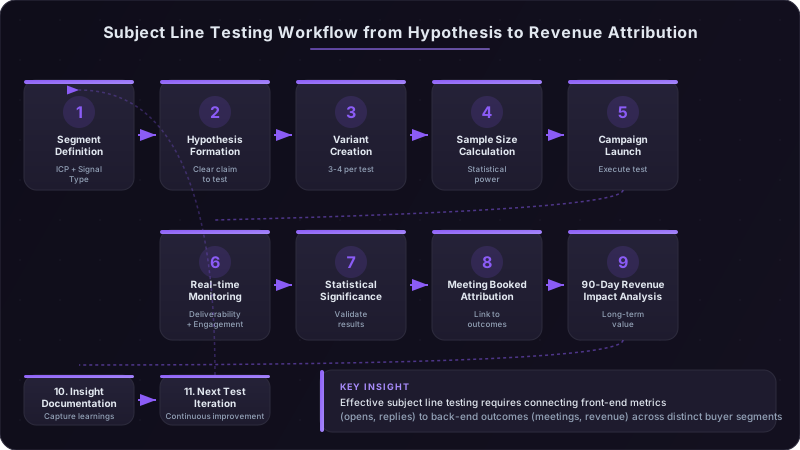
Subject Line Testing That Actually Drives Pipeline, Not Just Opens
Most teams optimize for open rates and lose deals. Here's how to test subject lines for reply rates and meeting conversion across different buyer segments.