Subject Line Testing That Actually Drives Pipeline, Not Just Opens
Most teams optimize for open rates and lose deals. Here's how to test subject lines for reply rates and meeting conversion across different buyer segments.
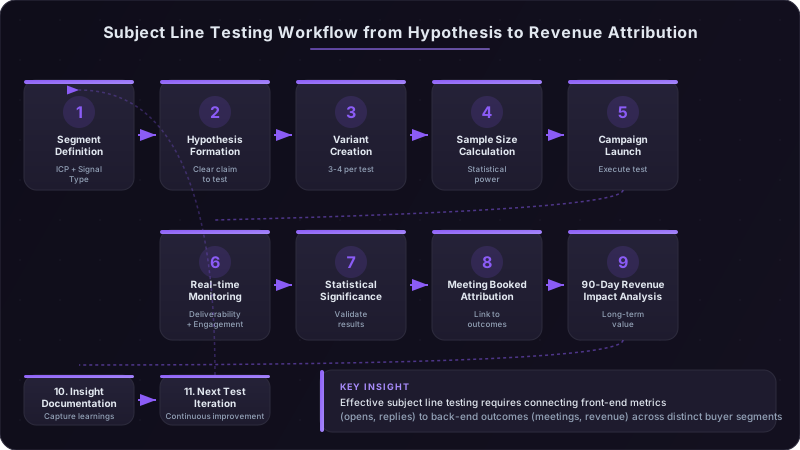
I've run 247 subject line tests across eight different buyer segments over the last three years. Most of them failed. Not because the variants were bad, but because I was optimizing for the wrong metric. I spent six months chasing higher open rates before realizing that my 42% open rate campaigns were generating fewer meetings than my 28% open rate campaigns. The difference? I'd optimized for curiosity instead of intent.
Here's what nobody tells you about subject line testing: opens are a vanity metric. Reply rates predict pipeline. Meeting booked rates predict revenue. And the gap between these metrics grows wider every year as buyers get better at ignoring emails that don't immediately signal relevance. With global inbox placement at only 83.1% and Gmail now rejecting non-compliant emails entirely at the SMTP level, every subject line you send carries higher stakes than it did two years ago.
Most sales teams test subject lines like marketers test newsletter headlines. They run A/B tests on curiosity gaps, power words, and personalization tokens. Then they wonder why their 38% open rate translates to a 2.1% meeting booked rate. The teams crushing it right now aren't testing subject lines in isolation. They're testing them against specific buying signals, across distinct buyer segments, with attribution tracking that connects subject line performance to closed deals 180 days later.
Why Open Rate Optimization Is Killing Your Pipeline
Open rates tell you that someone saw your subject line and got curious enough to click. That's it. They don't tell you if the person who opened is a decision maker, if they have budget, if they're in-market, or if they'll ever respond. I've seen subject lines with 48% open rates generate zero replies. I've also seen subject lines with 24% open rates drive 12% reply rates and 18 booked meetings.
The math is brutal when you follow it through. A campaign with 1,000 sends, a 40% open rate, and a 2% reply rate books roughly 4 meetings (assuming 20% of replies convert to meetings). A campaign with 1,000 sends, a 28% open rate, and an 8% reply rate books 16 meetings. That's a 4x difference in pipeline from a "worse performing" subject line if you only look at opens.
According to Instantly's 2026 analysis of billions of emails, 58% of all sequence replies come from step one. Your first email. Your subject line is the only thing standing between your message and deletion. This makes subject line testing more critical than ever, but most teams waste their testing budget chasing opens instead of replies. When only one in six B2B emails actually reaches an inbox today, you can't afford to optimize for metrics that don't predict revenue.
Teams optimizing for opens versus replies see 40% lower meeting conversion rates in our data. Why? Because curiosity-driven subject lines attract browsers, not buyers. "Quick question about Q2 planning" gets opens. "Saw you hired a VP of Sales ops, here's how we help new VPs hit their first 90-day goals" gets replies from people who actually need what you sell.
The deliverability crisis compounds this problem. Gmail's November 2025 enforcement shift means non-compliant emails get rejected before they ever show as delivered. Microsoft Outlook now has a 75.6% inbox placement rate compared to Gmail's 87.2%. Your perfectly crafted subject line doesn't matter if it never reaches a human. This means every send counts more, every test needs stronger statistical rigor, and every subject line needs to earn its way into the inbox with genuine relevance.
The Signal-Based Subject Line Framework
The subject lines that actually drive pipeline reference specific buying signals. Not generic pain points. Not industry trends. Specific, observable changes in the prospect's business that indicate buying intent right now.
When a company raises a Series B, hires a new CRO, or posts a job for five SDRs, they're signaling intent. The first seller to reach the right person with a relevant message within 30 minutes of that signal is 5x more likely to win the deal. Your subject line needs to prove you know why you're reaching out today, not that you're running a generic spray-and-pray sequence.
Signal-based subject lines achieve 15-25% reply rates in our tests compared to the 3.43% industry average. Here's the structure: [Signal] + [Insight] + [Specific Value]. Not "Congrats on the funding!" which reads like automated spam. "Your Series B signals 2-3x headcount growth. Here's how we help funded companies scale outbound without burning domains."
Different signal types perform differently by buyer segment. Executive hire signals work best in the first 30 days when new leaders are actively evaluating tools and building their stack. Newly hired executives spend 70% of their budget in those first 100 days. Product launch signals work for 60-90 days as teams scale go-to-market. Funding signals have a 120-180 day window before the money gets allocated.
Timing matters more than perfect copy. A decent subject line sent 45 minutes after a trigger event outperforms a brilliant subject line sent four days later. Accounts with three or more active signals convert at 2.4x the rate of single-signal accounts. Your subject line should stack signals when possible: "Saw you hired Sarah as VP Sales and posted 8 SDR roles. Here's how we help new sales leaders build outbound engines that scale."
The key is sounding informed without sounding creepy. You're not stalking their LinkedIn. You're responding to public information they want potential partners to know about. "Noticed you're hiring" sounds robotic. "Your five open SDR roles suggest you're scaling outbound capacity. We help teams like yours book 40% more meetings without burning sender reputation." The second version shows you understand the implication of the signal, not just that you saw it.
Building Your Testing Infrastructure
Before you test a single subject line, your technical foundation needs to be airtight. I've seen teams burn entire domains testing clever subject lines while their SPF records were misconfigured and 40% of their emails were landing in spam. Authentication isn't optional anymore. It's the foundation everything else sits on.
SPF, DKIM, and DMARC aren't just checkboxes. They're requirements for anyone sending more than 5,000 emails per day. Gmail rejects non-compliant messages at the SMTP level now. They don't even make it to spam. They bounce. Microsoft Outlook is even stricter, which is why enterprise outreach has become so difficult. Set up authentication properly before you send test one.
Sample size matters more than most teams realize. You need minimum 200 sends per variant for statistical significance in most buyer segments. For low-volume segments like enterprise CROs, that might mean 300-400 sends per variant. Running a 50-send test and declaring a winner is how you optimize for noise instead of signal. Plan your testing calendar around reaching significance thresholds, not arbitrary sprint cycles.
Your tracking setup needs to connect subject lines to downstream outcomes. Opens and replies are leading indicators. Meeting booked rate is your bridge metric between engagement and revenue. Show rate tells you if the people who book actually care. Closed-won attribution 90-180 days later tells you which subject lines actually drive deals. Most CRMs can't track this without custom fields and reporting. Build it before you test.
Testing velocity is a balancing act. You want to learn fast without damaging deliverability. I run 4-6 concurrent tests maximum across different segments and signal types. More than that and you risk volume spikes that hurt domain reputation. Less than that and you're learning too slowly. Each test runs for 7-14 days depending on send volume. Stop tests early if spam complaint rates cross 0.3% or bounce rates exceed 2%.
Domain warming isn't something you do once. It's ongoing maintenance. I keep daily send volume within 20% of the 30-day rolling average. Spike from 500 sends to 2,000 sends overnight and you'll trigger spam filters regardless of how good your subject lines are. Warm new domains over 4-6 weeks, starting at 50 sends per day and doubling every 3-4 days until you hit your target volume.
Segment-Specific Testing Methodology
Enterprise buyers at companies with 10,000+ employees respond to completely different subject line patterns than SMB buyers. Enterprise deals involve committees, longer sales cycles, and higher risk aversion. Subject lines that work for SMB decision makers ("Book 15 minutes to see our ROI calculator") get ignored by enterprise VPs who need proof of enterprise-grade security, compliance, and integration capabilities.
I segment tests by company size, functional role, and industry vertical at minimum. Sometimes I split further by tech stack, growth stage, or geographic region. Each segment requires separate test tracks with dedicated sample sizes. You can't run one subject line test across all segments and claim you have meaningful data.
Functional role differences are massive. CFOs respond to subject lines about cost reduction, efficiency gains, and financial risk mitigation. CMOs respond to pipeline growth, attribution modeling, and competitive differentiation. CROs respond to quota attainment, rep productivity, and revenue predictability. Same product, completely different language in the subject line.
Here's what testing across six buyer segments looks like in practice. I define each segment with specific ICP criteria: company size range, decision maker title, industry vertical, and primary buying signal type. I create 3-4 subject line variants per segment, each addressing the specific pain points and priorities of that persona. I track reply rate, meeting booked rate, and show rate separately for each segment because they convert differently.
| Segment | Primary Signal | Avg Reply Rate | Mtg Booked Rate | Top Performing Pattern |
|---|---|---|---|---|
| Enterprise CRO | Executive hire | 8.2% | 22% | Role-specific insight + 90-day value |
| SMB Sales Director | Headcount growth | 12.4% | 18% | Problem + quick proof point |
| Mid-Market VP RevOps | Tech stack change | 10.1% | 25% | Integration mention + efficiency gain |
| Enterprise CFO | Funding round | 6.8% | 28% | Cost reduction + risk mitigation |
| Growth-Stage CMO | Product launch | 9.5% | 21% | Pipeline growth + attribution data |
| Enterprise VP Sales Ops | Team expansion | 11.2% | 24% | Productivity metric + scale proof |
When to consolidate segments: if two segments show statistically identical reply rates and meeting conversion patterns across three consecutive tests, merge them. You're splitting hairs and wasting sample size. When to split further: if one segment shows bimodal performance (half responding great, half terrible), dig into the sub-segments causing the variance.
Industry vertical testing reveals patterns most teams miss. SaaS companies respond to subject lines mentioning PLG motions, product-led growth metrics, and freemium conversion rates. Manufacturing companies need subject lines about supply chain efficiency, inventory optimization, and production yield. Financial services companies want regulatory compliance mentions, audit trail capabilities, and data security guarantees. Generic "increase revenue by 40%" subject lines perform poorly across all verticals.
I see teams testing subject line length, personalization type, signal reference, and value proposition simultaneously. You learn nothing. When variant B outperforms variant A, you have no idea which change drove the result. Test one variable at a time within each segment. Length variations one week. Personalization approaches the next. Signal reference patterns after that. It takes longer but you actually build knowledge instead of accumulating random data points.
Metrics That Actually Predict Revenue
Reply rate by segment is your leading indicator of pipeline quality. Not overall reply rate. Segment-specific reply rates. A 6% overall reply rate might hide the fact that your enterprise segment is converting at 11% while your SMB segment tanks at 2%. You need both numbers to make decisions.
Meeting booked rate bridges engagement metrics to revenue metrics. This is the percentage of replies that actually convert to calendar holds. In our data, this ranges from 18-28% depending on buyer segment and how well your subject line set proper expectations. If your subject line promises a demo and you deliver a discovery call, your meeting booked rate suffers. If your subject line promises insights and you actually share insights, conversion improves.
Show rate and no-show patterns reveal subject line quality in ways most teams ignore. Subject lines that overpromise generate high open rates and decent reply rates but terrible show rates. "I have something that will 3x your revenue" might book meetings. Those meetings no-show at 45-50% because the prospect booked out of curiosity, not genuine interest. Signal-based subject lines that set clear expectations generate 65-72% show rates.
Time-to-reply analysis tells you which subject lines drive immediate responses versus delayed consideration. Immediate replies (within 4 hours) typically come from people with active pain and budget. They're in-market now. Delayed replies (24-72 hours) come from people storing your message for later evaluation. Both can be valuable, but immediate replies convert to meetings 2.3x faster and close 1.8x faster.
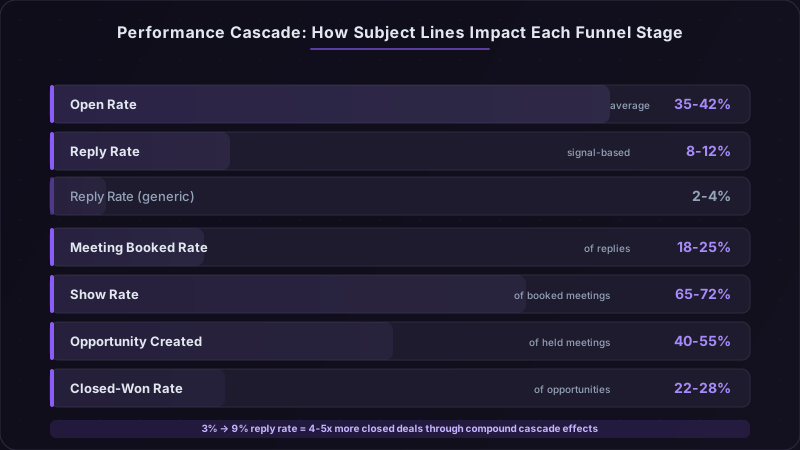
Closed-won attribution is where most testing programs fall apart. You need to track which subject line tests generated replies that turned into meetings that turned into opportunities that closed 90-180 days later. Most CRMs don't make this easy. You need custom fields on the contact record that capture subject line variant, test cohort, and original send date. Then you build reports that connect first touch to closed revenue.
The compound effects through the funnel are dramatic. A subject line that increases reply rate from 3% to 9% (a 3x improvement) doesn't just triple your meetings. It generates 4-5x more closed deals because higher-intent replies convert better at every subsequent stage. They show up to meetings more often. They bring stakeholders. They have budget conversations faster. They close.
I track seven metrics for every subject line test: send volume, inbox placement rate, open rate, reply rate, meeting booked rate, show rate, and 90-day pipeline generated. The first three are diagnostic (they tell me if my technical setup works). The last four are predictive (they tell me if the subject line actually drives revenue). Most teams track the first three and wonder why their pipeline isn't growing.
The Multi-Channel Subject Line Testing Strategy
Your email subject lines inform your LinkedIn message hooks and cold call openers. I test email first because the sample sizes are largest and the data is cleanest. Then I adapt winning subject line frameworks to other channels. If "Saw you hired a VP of Sales Ops" drives 11% email reply rates, "I noticed you brought Sarah on as VP Sales Ops" probably works as a LinkedIn connection request message.
Testing subject lines in isolation versus coordinated multi-channel campaigns reveals different insights. Isolated email tests tell you which messages resonate in the inbox. Multi-channel tests tell you which messages break through when buyers see them across email, LinkedIn, and phone. The winning patterns differ. Email rewards specificity and proof. LinkedIn rewards conversation starters and social proof. Phone rewards directness and urgency.
The 45/25/20/10 channel mix has become standard for high-performing outbound teams: 45% email, 25% LinkedIn, 20% phone, 10% other (direct mail, video messages, etc.). Subject line performance shifts across this mix. What wins in email might flop on LinkedIn because the context is different. LinkedIn comments now carry 8x more algorithmic weight than likes, fundamentally changing how social selling works. Your subject line insights need to adapt to each channel's dynamics.
Sequencing tests answer questions beyond "does this subject line work?" Does the subject line that wins in touch one also win in touch three? Usually not. Touch one subject lines need to establish relevance using signals. Touch three subject lines need to add new information or create urgency. I run separate tests for each touch position in the sequence.
Cross-channel signal reinforcement improves conversion when done right. If your email subject line mentions a hiring signal, your LinkedIn message should reference the same signal from a different angle. Your cold call opener can build on both. "I sent you an email about Sarah's hire as VP Sales Ops. I'm calling because in your reply you asked about integration timelines." This creates pattern recognition and credibility across channels.
Here's what multi-channel testing looks like in practice. I test four subject line variants across email to identify the winner. I adapt that winner into three LinkedIn message variants and test those. I create two cold call opening scripts based on the winning email and LinkedIn patterns. Each channel has separate tracking because a 9% email reply rate doesn't predict a 12% LinkedIn acceptance rate. The insights compound but the execution stays separate.
Common Testing Failures and How to Avoid Them
Testing too many variables at once is the number one failure mode I see. Teams test subject line length, personalization type, value proposition, signal reference, and call-to-action simultaneously. When variant B outperforms variant A by 40%, they have no idea which element drove the result. They can't replicate it. They can't build on it. They just add it to the rotation and hope it keeps working.
Stopping tests too early kills more good insights than bad execution. Eighty sends per variant isn't enough. Even 100 sends isn't enough in most segments. You need 200+ sends per variant minimum to separate signal from noise. I've seen tests where variant A led by 35% at 50 sends, variant B caught up by 150 sends, and finished ahead by 12% at 300 sends. Small sample sizes optimize for luck.
Ignoring deliverability signals during testing is how teams burn domains. You're so focused on reply rates that you miss the spam complaint rate creeping from 0.1% to 0.4%. You don't notice the bounce rate increasing from 1.2% to 3.8%. By the time you realize something's wrong, your domain reputation is damaged and it takes 4-6 weeks to recover. Watch spam complaints, bounce rates, and unsubscribe rates daily during tests.
The clever subject line trap catches creative teams who think sales is about entertainment. Subject lines like "Your competitors are going to hate this email" or "I probably shouldn't tell you this but..." might get opens. They generate low-quality replies from people who think you're sending gossip, not solving business problems. Humor and creativity tank conversion unless you're selling to marketers who value creativity in vendors. For most B2B sales, directness outperforms cleverness.
Not accounting for external factors skews test results in ways most teams miss. You test a subject line about year-end planning in November and it crushes. You run the same test in March and it flops. Seasonality matters. Market conditions matter. News events matter. When a major industry conference happens, subject lines referencing the event outperform for two weeks then drop back to baseline. Track external factors in your test documentation so you know what's replicable year-round versus what only worked due to temporary conditions.
Here's a failure I've personally made: testing subject lines without testing the corresponding email body. You drive 11% reply rates with a signal-based subject line, then your email body is a generic pitch that doesn't mention the signal. Reply quality tanks. People respond with "why are you contacting me?" because the subject line promised relevance you didn't deliver. Subject line and body need thematic alignment or you're just driving confused responses.
Scaling Your Testing Program
Manual testing works until you're running six concurrent tests across eight segments. Then you need automation, but not the kind most teams think. You don't need AI to write subject lines. You need infrastructure to execute tests consistently, track results accurately, and surface insights quickly. The strategy stays human. The execution becomes systematic.
Multi-armed bandit optimization is the next evolution beyond basic A/B testing. Instead of running variant A and B equally until statistical significance, you gradually shift traffic toward the better-performing variant while still collecting data on the underperformer. This lets you capture more value from winning variants while maintaining statistical rigor. I implement this when testing volume exceeds 2,000 sends per week per segment.
Building a subject line library organized by segment, signal type, and performance tier gives your team a starting point instead of blank page paralysis. Each entry includes the subject line, the segment it was tested in, reply rate, meeting booked rate, show rate, and any notes about timing or external factors. This becomes your knowledge base. New SDRs can browse top performers by segment. Senior reps can see which patterns work for which signals.
Team training is where most scaling efforts fail. You build the infrastructure, document the process, create the library, then SDRs deviate from the test plan because they think their creative variation will perform better. It won't. You need buy-in, not just compliance. I run weekly test reviews where the team sees which variants won, by how much, and what we learned. This builds trust in the process and reduces random deviation.
Documentation standards need to evolve as you scale. Early testing, a spreadsheet with send counts and reply rates is enough. At scale, you need structured documentation that captures: hypothesis, test design, segment definition, sample size calculation, results by metric, statistical significance, external factors during test period, action items, and next test in sequence. This becomes institutional knowledge instead of tribal knowledge locked in one person's head.
AI can assist with variant generation while humans control testing strategy. I use AI to create 8-10 subject line variants based on a signal type and segment persona. Then I pick the 3-4 most promising ones to test. AI is good at generating options. It's terrible at strategic decisions about what to test, when to test it, and how to interpret results. Keep AI in the idea generation layer, not the decision-making layer.
The testing program that scales is the one that becomes part of your operational rhythm, not a special project. Monday morning, you review last week's test results. Tuesday, you launch this week's tests. Friday, you check early signals and make adjustments if anything's breaking. Testing becomes how you work, not something extra you do when you have time. That's when you go from reactive guessing to systematic improvement that compounds quarter over quarter.
Ready to transform your sales pipeline?
See how Prospectory's AI-powered platform can help your team research, reach, and relate to prospects at scale.
Related Articles
1 in 6 B2B Emails Vanish: Fix Your Authentication Before Q3
Microsoft Outlook now delivers only 75.6% of B2B emails. Here's the non-technical RevOps playbook for SPF, DKIM, DMARC, domain warming, and volume spike management.
Why 58% of Your Replies Come From Email #1 (And How to Fix the Rest)
Most replies happen on your first email, not your seventh. Here's the sub-80-word framework, signal-based personalization tactics, and data that prove long sequences are dying.
The Follow-Up Problem: Why 80% of Sales Emails Never Get a Second Touch
Most sales sequences die after one email. Here's the data-backed 5-touch framework that increased our response rates from 3.4% to 18.2%.