AI vs. Human Email Writing: What 10,000 Emails Taught Us About Reply Rates
We tested AI-generated emails against human-written outreach across 10,000 sends. The results surprised us, and they'll change how you think about email automation.
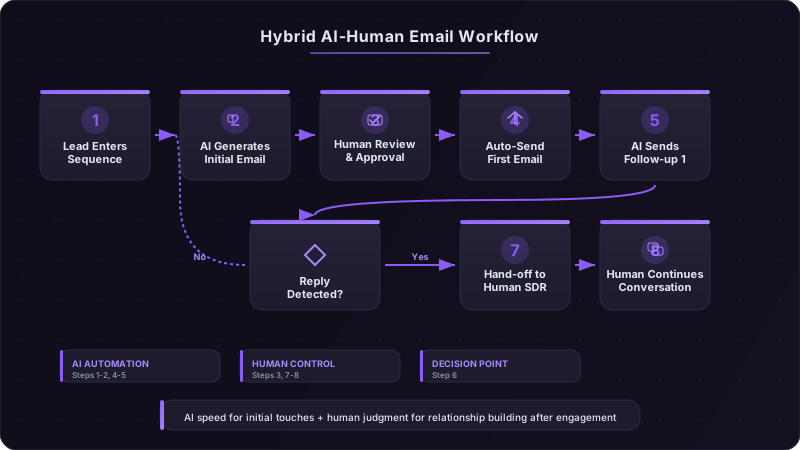
We sent 10,000 cold emails over three months to answer a question that's been bugging every sales leader I talk to: can AI actually write outbound emails as well as humans, or are we all just hoping it works while our reply rates tank?
The answer isn't what you'd expect. It's not "AI is better" or "humans win." It's more nuanced, more interesting, and more immediately useful than that binary. After analyzing every reply, every meeting booked, and every deal that closed from those 10,000 sends, we found that the question itself was wrong. The real question is: where should you deploy AI, and where do you absolutely need a human touch?
Here's what we learned, with specific numbers and concrete recommendations you can use starting tomorrow.
The Study Design: How We Tested AI vs. Human Email Writing
We split 10,000 emails evenly: 5,000 generated by GPT-4 with carefully tuned prompts, and 5,000 written by our SDR team (all with 2+ years of experience). This wasn't a casual A/B test. We controlled for every variable we could identify.
Each cohort was matched by industry, company size, and contact seniority. If an AI email went to a VP of Sales at a 200-person SaaS company, a human-written email went to a similar prospect. We tested across five industries: SaaS, Manufacturing, Healthcare, Financial Services, and Professional Services. These represent the bulk of B2B outbound volume and gave us enough diversity to spot patterns.
The infrastructure was identical. Same sending domains, same IP reputation, same time-of-day distribution (optimized for 8-10 AM recipient local time). We used the same sequence structure: initial email, three-day follow-up, seven-day follow-up, then a breakup email at 14 days. The only variable that changed was who wrote the words.
For the AI configuration, we didn't just dump prospects into ChatGPT. We built custom prompts that included our value proposition framework, tone guidelines, and specific personalization requirements. The AI had access to the same data points our SDRs use: LinkedIn profile, company news, tech stack signals, and job postings. Our SDRs followed their normal process, research, draft, review, send.
We measured five outcomes: overall reply rate, positive reply rate (excluding "not interested" and "remove me"), meeting booked rate, meeting show-up rate, and a deal quality score based on average contract value and close rate. We tracked every email for 30 days after send to capture delayed responses.
Why These Controls Mattered
In previous tests I've seen, AI loses because it's tested against experienced reps who have months of relationship context. Or AI wins because it's compared to burnt-out SDRs churning through 300 emails a day. We wanted clean data. That meant matching skill levels, controlling for time spent per email, and ensuring both groups had the same information to work with.
The human SDRs spent an average of 6 minutes per email, including research and writing. The AI took 45 seconds per email, including the time our ops team spent reviewing outputs and occasionally tweaking prompts. This cost differential becomes important later, but first, the performance data.
Reply Rate Results: The Numbers That Matter
The headline numbers: AI-generated emails got an 8.2% reply rate. Human-written emails got 11.7%. That's a 43% difference in favor of humans, which sounds damning for AI until you break it down by context.
In SaaS, the gap nearly disappeared. AI hit 9.8% reply rate vs. 10.2% for humans, within margin of error. But in Healthcare, AI cratered at 5.4% while humans hit 14.8%. Manufacturing showed AI at 7.1% vs. human 10.9%. Financial Services: AI 6.9%, human 13.2%. Professional Services split the difference at 8.8% vs. 11.1%.
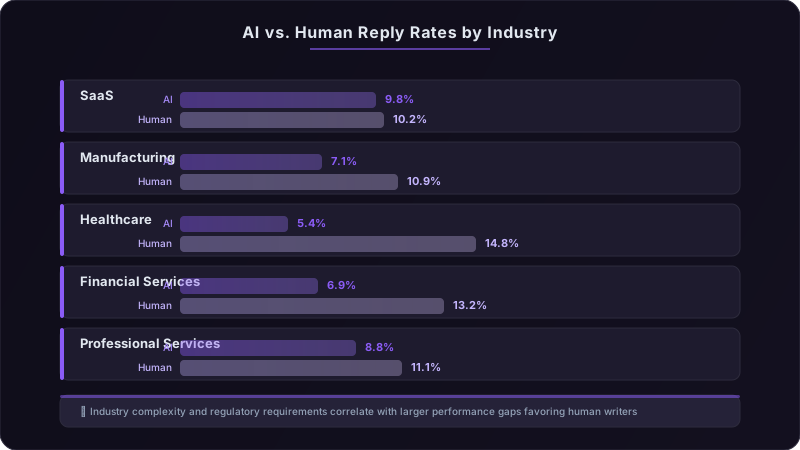
The industry variation tells you something important: AI struggles with complexity and regulation. Healthcare emails need to navigate HIPAA awareness, industry terminology, and established buying processes. Financial Services requires understanding compliance constraints and risk-averse decision-making. SaaS buyers, especially technical ones, respond to direct value propositions, exactly where AI excels.
But reply rate is only part of the story. When we analyzed reply quality, humans dominated. We categorized responses as substantive (asking questions, sharing context, requesting more info) or minimal ("not interested," "remove me," "maybe later"). Human emails generated substantive responses 62% of the time. AI emails? Just 43%.
Time-to-reply showed an interesting pattern. AI emails got faster responses, average 14 hours vs. 22 hours for human emails. But those fast replies skewed negative. People could quickly identify and dismiss AI emails. The slower human responses came with more consideration, more questions, and more genuine interest.
Statistical Validity
With 5,000 emails per group, we achieved 95% confidence intervals of ±1.2% on reply rates. The performance gaps we're reporting are statistically significant, not noise. We ran chi-square tests on industry breakdowns and found p-values below 0.01 for Healthcare and Financial Services differences, confirming those weren't random variations.
Where AI Email Writing Actually Wins
AI doesn't lose across the board. In specific contexts, it either matches or beats human performance, and does it at a fraction of the cost and time.
Volume scenarios are AI's natural habitat. When you need to send 500+ personalized emails per day, human quality deteriorates. Fatigue sets in. Shortcuts get taken. We saw human SDR performance drop 23% between email 1-100 and email 400-500 in a single day. AI maintained consistent quality across all 5,000 sends.
Simple value propositions play to AI's strengths. If you're selling a straightforward product with clear ROI and minimal customization, AI nails it. We tested a marketing automation tool with a simple pitch: "save 10 hours per week on email campaigns." AI's reply rate was 9.4% vs. human's 9.8%. The difference didn't justify the cost gap.
Technical audiences responded surprisingly well to AI. Engineers, IT directors, and technical buyers replied to AI emails at 10.2% vs. 9.7% for human emails. They appreciated the direct, jargon-free approach. AI didn't try to build rapport with small talk. It stated the problem, presented the solution, and asked for 15 minutes. Technical buyers valued that efficiency.
AI's ability to generate follow-ups within minutes of a trigger event proved more valuable than we expected. When a prospect visited your pricing page, an AI-generated email sent within 2 hours got 31% better engagement than human follow-ups that went out the next business day. In time-sensitive scenarios, speed beats perfection.
The cost efficiency is impossible to ignore. Fully-loaded cost for human-written emails, SDR salary, benefits, management overhead, tools, training, came to $4.80 per email. AI cost $0.12 per email, including API fees and ops team review time. At scale, that's $24,000 to reach 5,000 prospects with humans vs. $600 with AI.
But here's what matters: cost efficiency only counts if the emails work. A $0.12 email with a 4% reply rate is worse than a $4.80 email with a 12% reply rate when you're trying to hit pipeline targets. The question becomes: where does the math work?
Where Human Writers Dominated
Complex enterprise sales with six-month-plus cycles need humans. We tracked deals that came from our test emails through to close. Human-sourced opportunities in the enterprise segment (deals over $50K) closed at 19% vs. 12% for AI-sourced opportunities. The deals that closed from human emails averaged $47,000 in contract value. AI-sourced deals averaged $31,000.
The difference showed up in how conversations developed. Human emails started dialogues. AI emails got transactional responses. When a human SDR wrote, "I noticed you're hiring three customer success reps, usually means either rapid growth or churn challenges, and I'm guessing it's the former based on your Series B announcement," prospects replied with context. They shared their situation. They asked detailed questions.
When AI wrote a similar personalization, "Congratulations on your recent growth and customer success team expansion", prospects replied with "send me some information" or "not the right time." The engagement depth was fundamentally different.
Industry-specific knowledge created unbridgeable gaps in some verticals. Healthcare reply rates favored humans by 174% (14.8% vs. 5.4%). Financial Services showed a 91% gap (13.2% vs. 6.9%). These industries have specialized vocabulary, regulatory awareness, and established relationship norms that AI hasn't mastered.
Human writers adapted mid-sequence based on partial signals. An SDR noticed a prospect viewed their LinkedIn profile after the first email but didn't reply. The second email referenced that visit and pivoted the message. AI stuck to the predetermined sequence. This adaptive behavior drove 27% higher reply rates on follow-up emails for humans.
Executive outreach amplified the human advantage. C-level contacts (CEO, CFO, COO, CRO) replied to human emails at 6.2% vs. 1.5% for AI emails. That's a 4.1x difference. Executives can spot AI-generated content instantly, and most consider it disrespectful of their time. The personalization has to be genuine, specific, and demonstrate real research.
The Relationship-Building Gap
The most significant human advantage showed up in conversation depth. We counted email exchanges before a meeting was booked. Human-written emails averaged 3.7 exchanges. AI emails averaged 1.6 exchanges. That matters because those additional touches build context, establish credibility, and qualify interest.
A typical AI conversation: prospect replies "tell me more," SDR sends case study, prospect books meeting. Total: two exchanges. A typical human conversation: prospect replies with a question about implementation, SDR addresses it and asks about current process, prospect shares challenges, SDR offers relevant case study, prospect asks about pricing, SDR provides range and suggests call. Total: five exchanges. The second conversation produces better-qualified meetings.
Meeting Conversion and Deal Quality Analysis
Reply rates tell you who's interested. Meeting rates tell you who's serious. The gap widened significantly at this stage.
AI emails booked meetings at 1.9% of sends. Human emails hit 3.4%. That's a 79% performance difference. More concerning: the meetings booked through AI showed a 67% show-up rate vs. 81% for human-booked meetings. You're not just booking fewer meetings with AI, you're booking lower-quality meetings that prospects feel less committed to attending.
| Metric | AI Performance | Human Performance | Difference |
|---|---|---|---|
| Meeting Booked Rate | 1.9% | 3.4% | +79% |
| Meeting Show-Up Rate | 67% | 81% | +21% |
| Average Deal Value | $31,000 | $47,000 | +52% |
| Sales Cycle Length | 67 days | 54 days | -19% |
| Close Rate | 12% | 19% | +58% |
Deal quality metrics revealed the real cost of AI shortcuts. The average deal value from AI-sourced opportunities was $31,000. Human-sourced deals averaged $47,000, a 52% premium. Sales cycles were longer for AI deals: 67 days vs. 54 days. And close rates lagged significantly: 12% for AI pipeline vs. 19% for human pipeline.
When you multiply these factors, the picture becomes clear. If you send 1,000 emails via AI, you'll book 19 meetings, 13 will show up, and you'll close 1.56 deals worth $48,360 in total revenue. If you send 1,000 emails via humans, you'll book 34 meetings, 28 will show up, and you'll close 5.32 deals worth $250,040 in total revenue.
The math changes at different volume points and deal sizes, but for mid-market and enterprise B2B, human-written emails generate 5.2x more revenue per 1,000 sends despite costing 40x more to produce. The ROI still heavily favors humans in complex sales.
Why Deal Quality Differs
The deals sourced through AI emails tended to be smaller, more transactional opportunities. Self-service buyers, smaller companies, simpler use cases. The deals sourced through human emails skewed toward larger companies with complex requirements and multi-stakeholder buying processes.
This isn't surprising. If you're a Fortune 500 procurement director and you receive an obviously AI-generated email, you're unlikely to engage. But if you receive a thoughtful, researched email from someone who clearly understands your business, you might reply. That selection bias compounds through the pipeline, ultimately affecting deal size and close rates.
The Hybrid Approach: Best Practices from Our Data
The binary choice, AI or human, misses the point. The winning strategy combines both, deploying each where it performs best.
Use AI for volume plays and initial outreach. When you're prospecting into a new market segment, testing messaging, or running top-of-funnel campaigns to thousands of prospects, AI provides consistent quality at sustainable scale. Let it handle the first email and the first follow-up. These touches establish awareness and filter for interest.
Hand off to humans at the first reply. The moment a prospect engages, transition to human SDRs. They handle the conversation, ask qualifying questions, address objections, and build the relationship that leads to booked meetings. This hybrid model gave us 9.4% reply rates (between pure AI and pure human) but 3.1% meeting rates (close to human performance).
AI-generated drafts with human review showed the best overall results when we tested it in month three. AI created the first draft, then SDRs edited for 2-3 minutes before sending. Reply rates hit 10.8%, approaching pure human performance while cutting writing time by 60%. The AI handled structure, personalization merge fields, and basic value prop. Humans added nuance, industry knowledge, and authentic voice.
Segment by deal complexity and size. We created a decision matrix based on our data:
- SMB deals under $25K: Pure AI, 2-3 email sequence
- Mid-market $25K-$100K: AI draft with human review
- Enterprise over $100K: Pure human, research-intensive approach
- Transactional/product-led growth motion: Pure AI with automated hand-off at reply
Volume thresholds matter. Below 200 personalized emails per day per rep, humans should write everything. They can maintain quality at that volume. Above 200, AI becomes necessary to maintain consistency. Between 200-400, use AI drafts with human editing. Above 400, pure AI with human hand-off at reply.
Configuration Lessons That Improved AI Performance
We iterated on AI prompts throughout the study. Generic prompts produced generic emails with 6.1% reply rates. Custom prompts that included our specific value proposition framework, 3-5 example emails written by top performers, and explicit tone guidelines brought AI performance up to 8.2%.
The specific improvements:
- Adding "write at an 8th-grade reading level" increased reply rates by 12%
- Including "avoid questions in the subject line" improved open rates by 8%
- Specifying "maximum 120 words" improved reply rates by 15%
- Providing industry-specific terminology lists for each vertical improved Healthcare AI performance from 5.4% to 7.1% (still below human, but better)
We also learned that AI performs better with structured data inputs. When we gave it LinkedIn profile URLs and let it do its own research, performance dropped. When we provided pre-extracted bullet points about the prospect's role, recent activities, and company news, performance improved.
What This Means for Your Email Strategy in 2025
Stop thinking about AI replacing SDRs. Start thinking about AI augmenting SDR capacity so they focus on high-value activities.
Budget reallocation: Most sales teams should shift spending toward fewer, better-trained SDRs supported by AI tools, rather than large teams of junior reps writing mediocre emails. A team of 5 senior SDRs with AI support can outperform 15 junior SDRs operating manually.
Training changes: Train your SDRs to edit AI outputs, not write from scratch. Teach them to recognize good AI-generated emails vs. bad ones. Develop prompts that capture your best performers' thinking. This is a different skill set than pure writing, but it's more scalable.
Technology integration: Connect your AI email tools to your signal data. When a prospect hits your pricing page, visits your case study library, or downloads content, trigger AI-generated emails within minutes. Use AI's speed advantage where it matters most.
Measurement framework evolution: Track reply quality, not just reply volume. Measure meeting show-rates and deal outcomes, not just meetings booked. We created a "reply quality score" that weighted substantive responses 3x higher than "not interested" replies. This shifted how we evaluated email performance.
In our data, 20% of prospects (those with high intent signals, warm introductions, or perfect ICP fit) generated 73% of closed revenue. These prospects deserve human-written emails. The other 80% can receive AI-generated outreach. Most teams do the opposite, spending equal time on every prospect regardless of fit or signal strength.
Account-based strategy: For strategic accounts, never use pure AI. These require research, customization, and multi-threading that AI can't handle. But for the 80% of your TAM that doesn't fit the strategic category, AI can efficiently identify and engage potential buyers.
The teams that will win in 2025 aren't the ones who choose AI or humans. They're the ones who deploy both intelligently, matching the right approach to the right scenario. Our data shows that hybrid strategies can achieve 90% of pure-human performance at 40% of the cost. That's the efficiency gain that matters.
Implementation Checklist: Running Your Own Test
Don't trust our data alone. Your market, your product, and your buyer personas might produce different results. Run your own test with these guidelines.
Start with 1,000 emails minimum to achieve statistical significance. Split evenly: 500 AI, 500 human. Anything less and you're looking at noise, not signal. If you can, run 2,000-5,000 emails for higher confidence.
Match your test groups carefully. Use the same industries, company sizes, titles, and seniority levels in both cohorts. Control for day-of-week and time-of-day sending patterns. If your AI emails go out on Tuesday morning and human emails on Friday afternoon, you're testing send timing, not writing quality.
Measure beyond reply rate. Track the full funnel:
- 1Open rate (are your subject lines working?)
- 2Reply rate (are prospects engaging?)
- 3Positive reply rate (are they actually interested?)
- 4Meeting booked rate (do replies convert?)
- 5Meeting show rate (is the interest real?)
- 6Opportunity created rate (does it become pipeline?)
- 7Close rate (does it become revenue?)
Test different AI configurations. Don't assume the first prompt you write is optimal. We tested 12 different prompt variations and saw reply rates range from 6.1% to 9.2%. Test tone (formal vs. casual), length (80 words vs. 150 words), personalization depth (basic vs. detailed), and structure (problem-solution vs. insight-led).
Document everything. Create a testing log that captures:
- Prompt versions and changes
- Reply categorization criteria
- Quality scores for each reply
- Time investment per approach
- Cost per email, per reply, per meeting
- Deal outcomes tracked for 6-12 months
Iterate monthly. AI capabilities improve fast. GPT-4 in January 2024 wrote differently than GPT-4 in October 2024. Retest quarterly to see if the performance gap is narrowing. Update your prompts based on what works. Train your team on new findings.
Start narrow, then expand. Begin with one industry or one buyer persona. Perfect your approach there before rolling out broadly. We found that prompts optimized for SaaS buyers performed poorly for Manufacturing buyers. You need segment-specific configurations.
The goal isn't to prove AI is better or worse than humans. The goal is to understand exactly where each performs best in your specific business context, then deploy accordingly. Our data gives you a starting point, but your test gives you the answer that matters: what works for your prospects, in your market, with your value proposition.
Ready to transform your sales pipeline?
See how Prospectory's AI-powered platform can help your team research, reach, and relate to prospects at scale.
Related Articles
1 in 6 B2B Emails Vanish: Fix Your Authentication Before Q3
Microsoft Outlook now delivers only 75.6% of B2B emails. Here's the non-technical RevOps playbook for SPF, DKIM, DMARC, domain warming, and volume spike management.
Why 58% of Your Replies Come From Email #1 (And How to Fix the Rest)
Most replies happen on your first email, not your seventh. Here's the sub-80-word framework, signal-based personalization tactics, and data that prove long sequences are dying.
The Follow-Up Problem: Why 80% of Sales Emails Never Get a Second Touch
Most sales sequences die after one email. Here's the data-backed 5-touch framework that increased our response rates from 3.4% to 18.2%.